Wednesday, October 17, 2012

The Communcation Flow

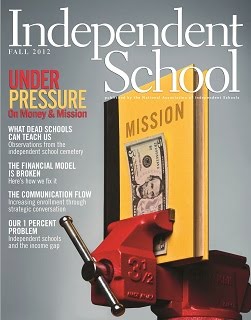
Recently I published a short article on how to market schools in Independent School magazine entitled "The Communication Flow: Increasing Enrollment Through Strategic Conversation." Here's an excerpt:

Enrollment drives the financial health of independent schools. When I began as an admissions director several years ago, this point was emphasized to me numerous times by our head of school. “Get more students,” he declared, “and we can solve our financial problems.” After I kindly brought up the realities of our competitive market, the global economic downturn, our stressed budget, and our declining enrollment trends for the past five years, he once again echoed: “Get more students.”

Not deterred, I started hunting for a cost-effective, systematic, research-based, yet highly personal, method for turning the tide of our admissions woes. After talking with several mentors and doing a bit of research, I stumbled upon a solution that is both simple and highly effective: a good conversation. In enrollment management, we just call it a “communication flow.”  

The Challenge — Bad Solutions to a Narrow Market
To fully appreciate this solution, we have to step back and consider the enormity of the challenge facing independent schools. As an admissions director at a K–12 school who came from higher education, my sympathy for enrollment officials in mid-sized private schools has grown exponentially. First, many schools face declining or stagnant enrollment, and are thus charged with recruiting more students without spending any more money. “We can’t spend more money on better facilities, new teachers, improved academic programs, or marketing or advertising,” the leadership will declare. “After all, our budget has been shrinking. But, we need more students. Go and find them for us.” This is no easy task.

Moreover, the market for independent education, at least where I live in Colorado, is incredibly narrow. Faith-based schools like ours compete for families who (1) share our beliefs, (2) are wealthy enough to afford a private education, and (3) see the value of independent education. When you crunch the numbers, this is an awfully narrow slice of the total population. Most marketers are like a bachelor who buys a new suit, finds the best singles bar in the city, meets a girl, and proposes marriage on the first date. (This is what most schools do when they ask prospective students to enroll after a 45-minute tour.)

The typical solutions to an enrollment challenge often fall short. (Read the rest of the article)

Tuesday, March 27, 2012

Lesslie Newbigin on Education

My favorite theologian, Lesslie Newbigin, on education:

In any discussion on the nature of society and of our vision for it, education must have a central place. Societies exist, cohere and flourish in so far as they embody a reasonably coherent understanding of existence within which they can make sense of their personal lives. Education, the its broadest sense, is the initiation of new members of society into this tradition. In contemporary British society the tradition into which young people are initiated in school and college is the set of assumptions which have controlled Western society since the Enlightenment. In a minority of homes – Christian, Islamic, Jewish and others – children are initiated into other traditions. In so far as these are at odds with the tradition into which children are initiated in school and college, they obviously fight a losing battle. Even in homes where the parents are committed Christians, it is hard, to the point of impossibility, for children to sustain belief in the meta-narrative of the Bible over against that understanding of the meta-narrative – the picture of the origins and development of nature, of human society as a whole – which is being offered to them at school. It is possible to maintain the telling of the biblical story in the privacy of home and church, but in so far as this story contradicts the meta-narrative of the schools, young people are placed in an impossible situation. The question ‘which is the true story?’ must ultimately be faced.

For the sake of the well-being of civil society as a whole, I believe that Christians have a duty to share with those who hold other beliefs, whether religious or secular, to create a public educational system which will train future citizens to live in mutual respect and mutual responsibility while acknowledging their differences in fundamental belief…But this pluralism cannot be sustained if one of these belief systems, namely ‘secular humanism,’ uses its present hegemony to exclude from the curriculum of public education the belief system which is embodied in the Bible. It is only the gospel which enables us to affirm both that the Sovereign Lord of all has made his will and purpose known in Jesus Christ for the whole of our life, private and public, and yet at the same time, not in spite of this but because of this, to affirm that God has ordained a space in which disbelief can have the freedom to flourish.

Friday, March 23, 2012

Classics in Theological Education

The following short story is from a personal journal entry on November 29, 2007, half way through my seminary experience.

Imagine you are a recent college graduate on the hunt for the perfect seminary. One day you arrive on campus a starry-eyed prospective student to behold a community buzzing with activity. Students are madly rushing to class and engaging in furious theological debate. You ask your tour guide what all the commotion is about, and he simply says, “It must be the faculty.”

Your curiosity peaked, you open the double doors to the academic building and take a peak into one of the classrooms. Standing along the back you notice that the professor seems to be dressed oddly, and is using an interpreter. “Who is that teaching?” you inquire. “Augustine of Hippo. He heads our theology department. John Calvin was recently added to our faculty as well. The students just love them.” You shoot back a quizzical look at the tour guide and continue the tour, not knowing whether to check his pulse or your own.

The next classroom has a much different flavor. Two monkish looking teachers are sitting in the corner with a small he Brd of student around them. “And who is teaching this class?” you ask. “Catherine of Siena?” “No, she's actually on sabbatical. Our current professors of spiritual formation are Ignatius of Loyola and Benedict of Nursia.” You shake your head, blink your eyes, and pinch yourself to make sure you're not dreaming.

Fluttering with excitement, you nearly run down the hall to the next classroom. Within you see Blaise Pascal teaching apologetics, with C.S. Lewis on deck as a guest lecturer. Astonished you fly down the hall to see Martin Luther King Jr. teaching theological ethics, and next door you see Gregory the gey team teaching a course on leadership. “What kind of a seminary is this?” you wonder. You pull out the course schedule to see if all the teachers are of this caliber, and you discover that Martin Luther teaches Greek exegesis, Ben-Hadad the Hebrew Scriptures, Plato and Thomas Aquinas teaching philosophy, Eusebius teaching early church history, Will Durant medieval and reformation history, Mother Teresa lectures on urban ministry, and the Apostle Paul teaches intercultural ministry along with his assistant William Carey.

Overwhelmed you shove the list back into your book bag, get a glass of water, and plop down at chapel. Yet before you can ask your tour guide what's going on, dozens of oddly dressed Jews come singing and dancing into chapel. “You're going to love this,” your tour guide quips. As scores of bearded men, who you discover to be Levites, pile in, you behold King David himself leading worship. The harp and lyre, the melody and lyrics, the commotion of prayer lift your imagination to a height that border exhaustion. After worship, Barnabas (from the mentoring department) introduces the preacher, none other than John Chrysostom – golden mouth himself. Enraptured by the legendary rhetoric and passion of the prince of preachers you near the point of complete elation.

Marching out of the chapel, you pull your tour guide outside and fanatically inquire, “What kind of a place is this? How do you keep these guys under control?” “Oh, don't worry, our President has a way with words. Actually, many even call him the Word.”

“I have one last question. How do I get into this school?”

Thursday, March 22, 2012

Private Schools for the Poor

One of the Millennium Development Goals is universal primary education. Despite a rise in attendance, 72m school-age children are still not in school, mostly in sub-Saharan Africa and Southwest Asia. Governments strive to meet the challenge of a free education for all, but a recent article in The Economist points out “A free education is something that many parents will pay to avoid.”

For instance, in India between a quarter and a third of students attend private schools. In Mumbai, parents are itching to get their kids into Mary Immaculate Girl’s School, which charges $180 a year. Considering there are free options across the street, this has made many reconsider the proper path to universal education.

Throughout India, as state systems expanded, quality slipped. Many teachers failed to show or to correct basic errors in student work. Contrast this with private schools in Ghana, Nigeria and Uganda. Here parents are choosy customers – and they care more about the quality of teaching than the glamor of facilities.

Can fee-based schools ever serve the poorest? Perhaps not. Many non-profits are skeptical of private schools and prefer to reform public schools instead. Nevertheless, for those interested in caring for the educational needs of children across the world, involving local parents as a system of accountability (they vote with their dollars) seems to me like a better solution than more large grants to the state.

Friday, March 16, 2012

School Architecture

Buildings shape your soul.

That may be hard to believe, but I think Stratford Caldecott, in his excellent book Beauty for Truth’s Sake, has convincingly made the case that architecture is under girded by distinct understandings of the world. And in the modern world, due primarily to materialism and utilitarianism, beauty has been mostly lost in our buildings. And with this loss in beauty, “ugliness” has warped aspects of the human soul.

Again, that may seem extreme, but Caldecott is worth hearing on a few points. The first relationship that he explores is the vertical and the horizontal in architecture:

“One way of describing what happened to architecture is that the vertical dimension was devalued, or else that the link between the vertical and the horizontal had disintegrated…. These two dimensions are integrated in the human body, which, as the medievals rightly perceived forms a “microcosm,” a compact representation and sampler of the cosmos as a whole. We stand upright, and this very posture hints at our potential role as a mediator or high priest of creation.”

Human beings stand upright, and, unlike most animals that stand horizontal, the vertical dimension of humans makes us unique. Thus, because humans are taller than they are wide, tall buildings tend to strike us as beautiful. "Humane architecture" proportionally connects the vertical and the horizontal. Or as Caldecott puts it:

“In general, buildings that are flat tend to strike us as drab and ugly, awhile buildings with peaked roofs, with triangles and curves that connect the horizontal with the vertical, are felt to be more beautiful.”

This is fascinating to me. My last apartment was flat and had normal 8ft ceilings. In my current home, the ceilings are vaulted, and they come to a peak at more than 20ft in height. Immediately when people walk in, they comment that our home is “beautiful.” Caldecott argues that this is because it resembles a human body, the most beautiful of all created forms.

He goes on to describe which materials are perceived as the most beautiful:

“The materials of which we make our buildings are just as eloquent. Traditional materials such as wood, stone or clay speak an immediate connection with the earth. On the other hand, concrete and cement by their very nature represent the brutality of modernism—the reduction of the world to particles in order to force it into shapes of our own devising. The shaping of concrete is done from the outside, by the imposition of mechanical force, rather than from inside by growth or natural accretion.”

Again, I had never thought about this before. Materials that have a connection to the earth – stone, wood, clay – are always more “beautiful” than concrete and cement. They resemble the created order and not the harsh imposition of force by humanity on a building.

These changes in architecture have a deeply philosophical basis. At the Enlightenment, the influence of the divine on architecture (not only on churches, but on schools and public buildings as well) was diminished, and utilitarian and human ends became ultimate. Caldecott says:

“In modern times, with the rise of rationalism and materialism, the transcendent or vertical dimension was neglected as we concentrated on mastering the world around us…One these attitudes and assumptions had sufficiently penetrated the popular mentality, architects began to create buildings that reflected the modern understanding of man and the world; that is, machines for living in, spaces designed to facilitate efficient motion in a horizontal plane.”
“Spaces designed to facilitate efficient motion in a horizontal plane…” Does this not sound like nearly every school you’ve ever been in? Certainly all K-12 schools, and a good many colleges and graduate schools are seen as only spaced to put bodies for “getting things done.”

I think we’ve all had the experience of being in a majestic building and feeling in awe. Or we’ve been in a wood cabin and felt deeply “at home.” Whether consciously or unconsciously, we've all felt what it's like to be molded by our surroundings.

Schools and churches should prioritize beautiful buildings. “But they cost so much!” Yes, they do. So save up, and build them when you have the resources. But let’s not fool ourselves into thinking that space is neutral. It’s not. And neither are buildings.

The buildings we reside in form our souls.

Wednesday, February 29, 2012

Beauty for Truth's Sake

Rarely do I finish a book and exclaim, “I have never even thought about most of these ideas.” Yet when I finished Stratford Caldecott’s Beauty for Truth’s Sake, I was dumbfounded. Although a bit heavy in quotations in some spots, this book opened a new world to me. That new world was the unity of knowledge. Christians often teach about not dividing sacred from secular and integrating the Bible into all of life, but most of these efforts amount to very little other than applying obscure Bible passages in strange ways. Caldecott, a Catholic theologian at Oxford, has given Christians interested in education a new vocabulary for “Christian worldview.”

The book is about the classical Liberal Arts tradition of the West that “once offered a form of humane education that sought the integration of faith and reason, and that combined the arts and the sciences, before these things became separated, fragmented, and trivialized.” For Caldecott, this tradition can only be recovered by going back to the sources (ressourcement). The most important source for Caldecott is not Boethius, Augustine or even Socrates and Plato. It is Pythagoras. Pythagoras? The right-angle triangle guy? That’s what I mean by “I’ve never even thought about that before.”

Caldecott introduces the book by quoting Pope Benedict at length. His book The Spirit of the Liturgy attempts to connect prayer and action, the soul and the exterior world, society and the universe, into a single harmonious whole. The ordering of the soul is deeply connected, of all things, to the mathematical ordering of time, space and matter. I’ll join Caldecott and quote Pope Benedict at length:

“Among the Fathers, it was especially Augustine who tried to connect this characteristic view of the Christian liturgy with the worldview of Greco-Roman antiquity. In his early work ‘On Music’ he is still completely dependent on the Pythagorean theory of music. According to Pythagoras, the cosmos was constructed mathematically, a great edifice of numbers. Modern physics, beginning with Kepler, Galileo and Newton, has gone back to this vision and, through the mathematical interpretation of the universe, has made possible the technological use of its powers.

“For Pythagoreans, this mathematical order of the universe (‘cosmos’ means ‘order’!) was identical with the essence of beauty itself. Beauty comes from meaningful inner order. And for them this beauty was not only optical but also musical. Goethe alludes to this idea when he speaks of the singing contest of the fraternity of the spheres: the mathematical order of planets and their revolutions contains a secret timbre, which is the primal form of music. The courses of the revolving planets are like melodies, the numerical order is the rhythm, and the concurrence of the individual courses is the harmony…

“But a further step was taken with the help of the Trinitarian faith, faith in the Father, the Logos [the Son], and the Pneuma [Holy Spirit]. The mathematics of the universe does not exist by itself, nor, as people now came to see, can it be explain by stellar deities. It has a deeper foundation: the mind of the Creator. It comes from the Logos, in whom, so to speak, the archetypes of the world’s order are contained. The Logos, through the Spirit, fashions the material world according to these archetypes. In virtue of his work in creation, the Logos is, therefore called the ‘art of God’ (ars=techne!). The Logos himself is the great artist, in whom all works of art—the beauty of the universe—have their origin.”

Let me try to summarize with my pea-sized brain: All of creation and thus all knowledge finds its source in Jesus, the Logos, the great bridge between God and man. He creates the world through an great ordering of all things (Genesis says God created order from chaos). This order is mathematical and constant, and the universe itself is set to a kind of rhythm that resembles a cosmic song. This “great edifice of numbers” carries with it a serene simplicity and unity that can only be called beautiful.

Western civilization lost its connection to a cosmic order at the Enlightenment. All was separated and dissected when, at the same time, it lost its faith in God. God became relevant only to one’s personal values, but was dethroned as God of the Universe. But in this vision of the world – this old vision – the natural world is the overflow of the Mind of the Maker. God is Lord of both the individual as well as the universe. Caldecott is trying to re-infuse meaning into education by recovering an ancient view of the world’s unity in Christ.

Like I said, I’ve never even thought about most of these ideas. I think this book will require several blog posts…

Swarthmore's Strategic Plan

I’ve just finished reading Rebecca Chopp’s new strategic plan for Swarthmore College. To most this will seem like snooze material. Yet leading large, complex organizations with highly intelligent people, most of whom have competing agendas, is no small task.

In the Strategic Plan, Chopp writes in lucid prose and begins with the challenges facing the liberal arts. She addresses issues like rising costs, student diversity, and global engagement in the 21st century. From here she clarifies the school’s most important values that guide their activity as an institution. She then calls the key points of the plan “recommendations” instead of “objectives”, the term most universities use. Each recommendation has several parts (read: goals) that will guide Swarthmore in the upcoming decade. Pretty straightforward.

But this is what I love about what Chopp has done. First, she engaged in a lengthy but defined process of listening. She formed councils on the strategic planning process, on mission, vision & values, and on admissions, access and affordability. All the key stakeholders were in these committees. Thus, when she would eventually present the institutions key values and “recommendations,” there was widespread buy-in. After all, it was all their ideas.

Second, she re-enforced her listening with collaboration. After she had written the plan, she presented a “draft for comment.” Banish the idea of a headstrong leader charging in and saying “Here we go. Follow me!” Instead, she spent several more months receiving additional ideas before it was set in stone. People we given a chance to voice their objections before the plan was finalized.

Chopp must have read Peter Senge’s The Fifth Discipline. Senge argues that shared vision is the most powerful organizational force, and that the role of the CEO is to understand and then articulate the vision that is already within the company. No more “my way or the highway.” Instead, it becomes, “Let’s create a new company and a new world together.”

What a good way to lead.

Monday, February 27, 2012

The New American University

After reading about Fred Terman several weeks ago, I sent a letter to Jonathan Cole, author of The Great American University and professor at Colombia. My question was this: Who are the great university leaders of our generation? Six weeks later he graciously sent a reply. At the top of his list was the president of Arizona State University: Michael Crow.

Crow has been noticed by many in higher education for his big idea, which he calls The New American University. By way of introducing the idea, in an ASU promotional brochure, Crow comments, “Do you replicate what exists or do you design what you really need?” For Crow, the university is not about doing research in a never-ending spiral of footnotes (replication), but in looking at the big problems of the world and creating useful knowledge.

The New American University (an idea Crow hopes will catch on past ASU), is defined by eight “design aspirations.”

1. Leverage our Place. By embracing the physical, cultural and socioeconomic location of ASU, new initiatives and partnerships are built around the needs of Arizona and the Southwest in general.
2. Transform Society. Social needs form the objectives for research programs, and have thus inspired new institutes and projects ranging from biomedical research and sustainability to health care and K-12 education.
3. Value Entrepreneurship. Here entrepreneurship extends far past the business school, and is encouraged in every field.
4. Conduct Use-Inspired Research. If your Ph.D. research has no apparent use in the modern world, then it might be better to look elsewhere for graduate school. Since 2003 investors have devoted over $100 million for new ventures from ASU Techonopolis alone. Research has a practical goal at ASU.
5. Empower Our Students. Here access triumphs over elitism. From partnering with the American Indian Community to launching the American Dream Academy, an institute that helps to instill the value of education in both parents and children, ASU works to give unprecedented access to higher education, as well as empowering students from all walks of life to succeed.
6. Fuse Intellectual Disciplines. ASU has gone crazy in the past decade creating over 20 new transdisciplinary schools and institutes, such as School of Sustainability, School of Earth and Space Exploration, the Center for Biology and Society, and the Arizona Institute for Renewable Energy.
7. Be Socially Embedded. ASU now has dozens of partnerships with local hospitals and schools throughout Arizona that make ASU a genuine agent of widespread social change.
8. Engage Globally. From MBA partnership programs in Shanghai to studying abroad at the Technológico de Monterrey, ASU engages the needs of the world.

Like a previous post about A New Liberal Arts, the idea is simple: our communities, states and nations have needs, and we need to reformulate higher education around engaging those needs. Liz Coleman at Bennington is doing it primarily among undergraduates and the liberal arts. Crow has transformed ASU from a top ten party school to an engine of useful innovation.

There’s much that could be said (and has been said) about Crow’s efforts to build a new model for higher education. But what really interests me is the deep connection between thinking and action, between the needs of the world and the intensive intellectual process required find creative solutions to meet those needs.

I’ve said this before, but Christians need to really pay attention to these voices. Given, these are both highly secular institutions. But they are in many ways shaming Christian educational leaders who are simply replicating what “bigger, better” schools do and haven’t deeply thought about creating academic programs that are focused on solving the big problems of our day.

I do genuinely think higher education will have to move in the direction of The New American University. Exponentially rising tuition costs have cornered many in the university. Students are laden with debt, and administrators must answer more and more to a public that demands a quality undergraduate experience.

This model is missing a key factor, however. God. And because God is missing so is the both the unity of knowledge and the keys to answering the biggest questions about human existence. But this model puts many Christian universities to shame who claim to be about God’s mission in the world but many times amount to little more than, in the words of a skeptical friend of mine, “pay your fee, get your degree.”

Christ calls educators to serve the needs of others. Michael Crow seems to me to be one of the great Cyrus’ of our generation, serving the needs of others and even the purposes of God, perhaps while not even knowing it. I wonder how many Christian institutions of education will notice this model and have the courage to refashion their own schools and universities around this model. Or perhaps some will not simply replicate this model and will instead design what their communities really need.

Friday, February 24, 2012

The Reason for Christian Schools

I’m often interested in hearing the reasons why parents bring their kids to a Christian school. One of the most common is the negative influences on their child at a public school. Parents don’t want their children surrounded by peers who are drinking, using drugs, using foul language, or perhaps engaging in premarital sex. More importantly, they don’t want their child bullied or picked on by other students.

As a parent, I can fully understand this perspective. I have a three-year-old and a one-year old. Nothing makes me more worried, or even potentially angry, than thinking about my daughter coming home and either being bullied or picking up the sinful behaviors of their peers. As a parent I’ve been entrusted with the formation – intellectual, spiritual, emotional, and physical – of my kids. I’ve been charged by God to put them in an environment where they will thrive and flourish.

There is, however, a problem that can develop out of this mentality. When the focus is on “what other kids might do to my child,” it becomes assumed that the problem is “out there.” The problem exists in other kids, in the public school, in their teacher, or whatever other external influence that might negatively affect my child. Regardless of what the external problem is, over time it becomes assumed that I must protect my child from an evil world.

This, however, is not a Christian view of the world.

For the Christian, the fundamental problem is sin. And sin is not only “out there”—in the structures of society and in other people—it is within me. Augustine’s concept of original sin (based on Romans 5), means that all human beings adopt a sin nature from Adam, and they simultaneously choose to embrace that sin. As a matter of fact, the starting point for the whole Christian life is the confession, “Lord Jesus, have mercy on me, a sinner.” I am a sinner. And so are my children. The problem is not so much “the evil world” that will hurt my child, the problem is the sin inside them that threatens to disintegrate their personalities before they can ever grow.

GK Chesterton once was asked by a newspaper editor what he believed to the world’s biggest problem. Was it warfare, poverty, pollution, education, government corruption? No. To the question of “What’s the biggest problem in the world?”, Chesterton famously replied, “I am.”

This is the answer of a Christian who has fully understood the human problem, and has seen the problem deep within his own heart.

When a school community adopts the first view, that the problem is “out there” and we need to protect our kids from “them,” it can often lead to not only sheltering kids, but making them think that “they are bad and I am good.” This can lead to a pharisaical religious superiority that condemns others for their sex, drugs and rock & roll lifestyle, and almost completely ignores the greatest sin living in their own hearts: pride.

On the other hand, when Christian parents fully understand the gospel, that I (and my children) am a sinner and Christ has atoned for my sins at the cross, they base their life and beliefs on grace. We as a family have been given a gift we didn’t deserve, and this informs how we interact with other students and their families. A quick willingness to admit our own sin is the result, and we look at others as more righteous than ourselves.

I can understand the desire to put quality influences in the life of your child. This is certainly important for any Christian family. But Christian schools (just like churches for that matter) are filled with people who have problems. We can never fully protect either ourselves or our kids from bad influences, because the bad influence starts with the sin living inside of us!

The real case for a Christian school, in my view, is that it’s an environment soaked by the gospel of God’s grace. The gospel alone has the power to transform lives. Secular knowledge alone can’t transform either the human heart or society. When the gospel is integrated into every aspect of learning and community life, it has power to allow children to flourish. It is, in the words of Paul, “the power of God for the salvation of everyone who believes.”

Sunday, February 12, 2012

The Bible Made Impossible

I recently published a review of Christian Smith's The Bible Made Impossible: Why Biblicism Is Not a Truly Evangelical Reading of Scripture for The Denver Journal. Here's the first paragraph:

It’s not often that a professor attempts to dissolve the edifice of evangelicalism with a single book. But that is essentially what Christian Smith, Professor of Sociology at Notre Dame, has tried to do with his latest work The Bible Made Impossible: Why Biblicism is Not a Truly Evangelical Reading of Scripture (Brazos Press, 2011). Perturbed with popular use of the Bible in American evangelicalism, Smith decries modern “biblicism” (defined below) as not only irresponsible, but “impossible” – a theory that doesn’t work in practice. He endeavors to show readers the flaws of biblicism and then make a case for a “truly evangelical” reading of Scripture. Although peppered with helpful insights, The Bible Made Impossible falls short of its lofty goals, and leaves readers looking for solid ground amidst the shifting sands of academic criticism. (Here's the rest of the article...)

Tuesday, January 31, 2012

Prison University Project

Several months ago I was driving to work and overheard a program on NPR about “The Prison University Project.” In San Quentin Penitentiary, ex-cons and felons, (incarcerated for crimes ranging from drug dealing to murder) have the opportunity to get a liberal arts degree through a unique program launched in the mid-nineties by a UC Davis professor. An extension site of Patten University, prisoners with at least a GED or high school degree can earn a two year liberal arts degree, with classes ranging from US History and Algebra to English Composition and philosophy. At least in one US prison, inmates trade in dope dealing for Kant, integrals, and civil war history.

So how does one pull off a university extension site behind bars? Well, the teachers are nearly all volunteers, all with at least a masters degree in their field. Because the government outlawed Pell Grants for inmates in 1994 (a “disaster” according to the Prison University Project (PUP) website), all funding is through private foundations and donors. Students must apply and be accepted into the program, with the criteria being centered on how bad a student wants to improve themselves and grow. Classes are held primarily in evenings, and students do homework throughout the week.

What’s the need for such a program? For one, the recidivism rate among inmates is a major problem. With 2.6 million prisoners in the US, it's problematic when inmates often learn in jail how to become better criminals. If one wanted to improve himself, the typical opportunities in jail are either work programs or GED programs, which give ex-cons just enough education to get a minimum wage job upon release and be eventually drawn into “more lucrative” affairs on the street. The Prison University Project offers are real alternative – a way to earn an accredited degree and a shot at a brighter future. Moreover, a liberal arts education gives students the ability to adjust to several different jobs upon re-entry, and not only in narrowly defined technical jobs that may or may not be available when their parole is up.

But does this program really work? Who’s going to hire an ex-con to work at their corporation, even if he has a liberal arts degree? Bard College launched a similar program in an attempt to answer this question. In contrast to PUP, the Bard Initiative offers four year degrees, and produced graduates in fields ranging from computer science to comparative literature.

One student at the Bard Prison Initiative, Anthony Cardenales, graduated from the program and was eventually hired by a company called WeRecycle!. Cardenales had a unique set of skills that made him a perfect fit for WeRecycle!. First, because he was just getting out of jail, he was highly motivated to work hard, even on the floor as a materials handler. Failure was not an option for Cardenales, and his work ethic eventually pushed him up to management. But what was unique about Cardenas is that he combined a work ethic with a liberal arts degree, which gave him the critical thinking skills and higher reasoning ability needed to solve company-wide problems. In contrast to either those who will do menial labor yet are not capable of leadership responsibilities, or those with a college degree who won’t “get their hands dirty,” Cardenales brought together both skills because of his unique background.

I’m drawn to programs like PUP for many reasons. First, here is a form of education that is really changing lives. Students who are admitted have both the direct need and the motivation to change. Also, PUP is also solving a fundamental social problem in America: the recycling of prisoners through the US prison system. Graduates of programs like the Prison University Project are given the tools to truly “make it” on the outside. Yet, what is most beautiful about these types of programs is the dynamic harmony between the life of the mind and social justice, between what Bertrand Russell deemed the “heaven of philosophy” and the suffering of mankind. Here is an opportunity for the intellectually, and often introspectively, oriented individual to use his or her skills for the good of another. This is a great opportunity for those on the outside to walk along side of another human being and see them transform over time to become a contributing member of society.

Here’s my question: when is somebody going to start a program like this in Denver?

Wednesday, January 25, 2012

A New Liberal Arts

Several years ago, Liz Coleman, the president of Bennington College, gave a talk at TED about “A New Liberal Arts.” At a conference usually reserved for technology whizzes or scientists, she gave a convincing argument for the worth of a liberal arts education in an age where hyper-specialization is seen as the apex of human endeavor. Yet what was most compelling to me was her central idea: the liberal arts must be intentionally focused on thinking about and solving the world’s biggest problems.

Here’s the idea: in today’s world, not only do we need people who can think in interdisciplinary ways, but we need people using the best tools of thought from history (literature, science, history, economics, philosophy, rhetoric, mathematics) to be intentionally engaged in solving difficult problems. From climate change and education reform to international conflict and malnutrition, Coleman doesn’t believe the technician can solve these problems alone. They need broad thinkers, and they need a moral vision.

Now, I significantly disagree with several aspects of Coleman’s vision. For one, she’s staunchly secular and anti-religious. In her talk, she even spoke about their new research center at the center of campus as a kind of “secular church.” She sees no place for religion in the academy, and this, I believe, damages her argument in a religious world. Second, her form of education is avowedly political. Without God, she needs an ultimate purpose, and for her that is the state. Considering 20th century history, I’m not sure how she could be so adamantly political and unflinchingly believe in the virtues of even democracy, whom Churchill has even said is only “the least bad form of government we have.” As one who sets her heart on the state, Coleman would be wise to at least admit the truth: the secular academy is her church, and secularism is her religion.

But setting this aside for the moment, I’m more than fascinated by this model of education. Here’s why. First, Coleman believes that directly connecting a human need or real-world issue to a liberal arts curriculum super-charges thinking. For example, her freshman all have to sit in on “labs” focused on some issue, such as education or health care. In class, when they read Whitehead’s The Aims of Education, they apply it’s lessons to the national education reform debate. How many times have each of sat in class and wondered why we have to learn this? For students at Bennington, it’s clear: to change society. This means syllabi and pre-fabricated papers take second place to real critical thought on the toughest problems of our day.

Second, there is always a criticism that education is an ivory tower, disconnected from “the real world.” Not here. In this new liberal arts curriculum, the core ends are not only mastery of a subject, but instead the mastery of using that subject to benefit the common good. Conversations on literature and history take on new significance when you’re required to do a semester of “field work” dealing with real problems like poverty, governance, or disease.

Third, this new liberal arts curriculum, I believe, is deeply missional. Now, it’s obvious Coleman would never agree with me on this. I’d probably classify as a nutty fundamentalist in her eyes. But having this outward focus in a liberal arts curriculum I believe is resonant with God’s activity in the world. In contrast to most Christian liberal arts curriculums that only do mission trips and service projects, this re-centers the curriculum itself around the pressing issues at hand. For example, instead of going to Central America to build a school, they would analyze the issues of public education in Central America as well as the challenge of development education in their actual courses. God is in the business of bringing, in the words of the Lausanne Covenant, the whole gospel to the whole world. Solving problems like climate change or corporate corruption as a part of a liberal arts curriculum saves The Great Conversation from being stuffy and elitist. It focuses the liberal arts where Milton says it should always be focused, “on repairing the ruins of our first parents.”

Monday, January 9, 2012

Knowledge and Suffering

Vernon Grounds, the former Chancellor of Denver Seminary, quotes atheist philosopher Bertrand Russell to conclude his short work Evangelicalism and Social Responsibility. As an educator myself who, like Grounds, cares deeply about social justice, I thought it fitting to include the quote on this blog:

“Three passions, simple but overwhelmingly strong, have governed my life: the longing for love, the search for knowledge, and unbearable pity for the suffering of mankind. These passions, like great winds, have blown me hither and thither, in a wayward course, over a deep ocean of anguish, reaching to the very verge of despair.

“Love and knowledge, so far as they were possible, led upward toward the heavens. But always pity brought me back to earth. Echoes of cries of pain reverberate in my heart. Children in famine, victims tortured by oppressors, helpless old people a hated burden to their sons, and the whole world of loneliness, poverty, and pain make a mockery of what human life should be. I long to alleviate the evil, but I cannot, and I too suffer.”

This morning I read a headline in the Denver Post about 550,000 Haitians still living in tent cities without running water or sewer lines two years after the earthquake. One father of two young girls said, “It’s hell.” As we educators continue to pursue truth and knowledge that lift us and our students to the heavens, let us never forget of the suffering of mankind. And as we plunge back to earth, perhaps we can take something from the silver lining that will alleviate the pain that makes a mockery of what human life should be.

Revelation

“You are worthy to take the scroll
And to open its seals,
Because you were slain,
And with your blood you purchased men for God
From every tribe and language
And people and nation.
You have made them to be a kingdom and priests to serve our God
And they will reign on the earth.”
-Revelation 5:9-10

On this blog I often consider the purpose of education. Why teach? What are we trying to form in students? To find an answer to these questions, it’s helpful to think about the more fundamental question, What is the purpose of the human race?

As Lesslie Newbigin has pointed out in Foolishness to the Greeks, purpose and meaning are always connected to final outcomes. For example, if I see a machine making Coke bottles, I know it’s purpose: to make bottles. But if I see the machine sitting in a corner with a piece missing, I have no idea what its purpose is.

In the same way, the purpose of humanity is connected to its final outcome. And the final outcome of the human race is outlined in Revelation. Now, the book is interspersed with songs and poems, sung primarily by angels, but also by the “twenty-four elders” and “the four living creatures.” The elders and the four living creatures sing the song written above. To me, it’s interesting to look at the types of things people and will be doing and saying in eternity, especially as I think about what I should be doing and saying now.

The song above has at least important ideas: gospel, global mission, service, and dominion. First, the gospel is eternally on the tongue of both men and angels: the Lamb has been slain and has purchased men for God at the price of his blood. Second, people from “every tribe and language and people and nation” are at the wedding feast of the Lamb. It is a multi-cultural event. Third, men who were once far from God and estranged from him are made to be “a kingdom” and “priests” who serve God. Priests intercede on behalf of others, and service is, it seems, an eternal activity. Finally, men once again are restored to the role of being kings on the earth who reign, and thus steward the entire created order and oversee its restored state.

As we consider models of Christian education, are the elements of gospel, global mission, service and stewardship over the earth included in our curriculum? The songs of angels and redeemed people offer us clues to a true formation for students, resulting ultimately in worship.

Friday, December 30, 2011

The god of Technology

Occasionally on this blog I will quote authors at length without much commentary. Neil Postman, author of The End of Education, is just such an author. One of the topics he treats in this profound work is the topic of technology. He writes: “But nowhere do you find more enthusiasm for the god of Technology than among educators.” But, a god? What does he mean? Let me quote Postman at length.

“As the discussion proceeds, important distinctions are made among different meanings of “belief,” but as some point it becomes far from asinine to speak of the god of Technology—in the sense that people believe technology works, that they rely on it, that it makes promises, that they are bereft when denied access to it, that they are delighted when that are in its presence, that for most people it works in mysterious ways, that they condemn people who speak against it, that they stand in awe of it, and that , in the born-again mode, they will alter their lifestyles, their schedules, their habits and their relationships to accommodate it. If this is not a form of religious belief, what is?”

Postman is not against technology; he’s simply making the case that people unthinkingly adopt technology without really thinking about its impact. Certainly, the computer and the internet have drastically altered human life. But, as Postman argues,

“Like all important technologies of the past, they are Faustian bargains, giving and taking away, sometimes in equal measure, sometimes more in one way than the other. It is strange—indeed, shocking—that with the twenty first century so close on our heels, we can still talk of new technologies as if they were unmixed blessings, gifts, as it were, from the gods.”

The problem, says Postman, with much of our technology in the information age is that students are overwhelmed by information. It’s not that they don’t have access to enough information. That problem was solved about a century ago. The problem is that our students are inundated, like a watery abyss falling from the skies, with data. Postmas uses the example of “little Eva.”

“For Little Eva’s problem is not how to get access to a well-structured algebra lesson, but what to do with all the information available to her during the day, as well as during sleepless nights. Perhaps this is why she couldn’t sleep in the first place. Little Eva, like the rest of us, is overwhelmed by information. She lives in a culture which has 260,000 billboards [Postman is writing over a decade ago], 17,000 newspapers, 12,ooo periodicals, 27,000 video outlets for renting tapes [does anybody have current stats for Netflix?], 400 million television sets, and well over 500 million radios, not including those in automobiles.”

Postman, I believe, would agree with Tim Keller, pastor at Redeemer Presbyterian Chruch in New York City, who said, “The internet is the friend of information but the enemy of thought.” Keller, as one of the few genuine cultural leaders in the Christian movement, tries to stay away from the internet as much as possible, and read books, whole books, instead.
Postman is not arguing against computers in schools, but he is arguing against the “sleepwalking attitudes toward it, against allowing it to distract us from more important things, against making a god of it.”

Postman cites Alan Kay, who is widely associated with the invention of the personal computer. “He has repeatedly said that any problems the schools cannot solve without computers, they cannot solve with computers.” Perhaps this is the reason that many of the sons and daughters of today’s Silicon valley moguls working at places like Google send their kids to a Waldorf school where kids don’t have any computers until 8th grade.

What we really need is technology education – learning about how technology affects the human person and surrounding society. This seems to be the best way to guard against the favorite god of educators – the god of technology.

A Cantankerous Professor

I just finished reading James Kittleson’s classic biography of Martin Luther over Christmas break. Honestly, I was shocked by Luther’s life. Cantankerous and contentious doesn’t even come close to describing the real Luther. Having grown up under Lutheran pastors who more closely resembled Mr. Rogers than any of the reformers, learning about Luther’s exploits, condemning nearly everybody who disagreed with him (often with the most colorful language), made me think twice about the reformation.

Although the book was excellently written and well-researched, I couldn’t help but feel heavy about Luther’s life. First, I should say that I radically admire his courage. Luther took on the entire structure of medieval life and thought in the Catholic Church. From his criticism of the selling of indulgences to his insistence that men are justified only by God’s grace, and not by any works of “love,” he quickly made some powerful enemies. The pope and his emissaries quickly tried to silence this noisy Augustinian monk. But Luther’s conscience was bound to defend the faith as he understood it based on the Scriptures – and he was protected by a powerful German prince which ensured his teaching would continue. Moreover, as a “doctor of the church,” he took his vow to proclaim the truth and expose falsehood seriously. He feared literally no one, and no consequence. From peasant to emperor, if they spoke against the truth of God’s Word, all were fair game. His pen was one of the mightiest forces in Europe.

Having said this, Luther was reckless, arrogant, rude, and often a crushingly negative force, not just to enemies, but even to friends. Take the example of the Sacramentarian Controversy. The controversy was about Jesus’ words “This is my body” in reference to the Lord’s supper. Was his body really present in the bread and wine, or was it merely symbolic? Luther took the view that it was really Christ’s body, while other reformers like Zwingli believed it to be symbolic. Not only were reformers like Zwingli “false brethren” but they were also Satan’s followers. They replied to Luther “These are the words of an angry man.”

This is a fitting summary of Luther: an angry man. He engaged in the most extreme polemics, not only regularly calling the pope the Anti-Christ, but also accusing the mild-mannered and like-minded critic of Rome Erasmus of not even being a Christian because he didn’t agree with Luther on the issue of the freedom o f the will. From the despised catholic hierarchy to the Anabaptists, all were subject to name-calling and public defamation. He didn’t reserve his invective pamphlets for only those who sold indulgences like Tetzel – any and everyone who contradicted Luther has subject to the force of his criticism.

Two things astound me about Luther. First, how was he so sure he was right? How could any one man take on nearly the whole world and be astounded that anybody disagreed? He was once asked by one of his opponents, “Are you alone wise?” If he were alive today, I would ask him the same thing.

Second, was Luther not one of the most divisive forces in the history of the church? As a protestant myself, it’s tough to ask this question. His reforms, I believe, needed to happen. But Luther almost single-handedly tore Christendom apart. German princes pounced on the opportunity to declare independence from the Roman Church and Charles V, the Holy Roman Emperor. And in the decades that followed, Protestants and Catholics fought bloody wars, culminating with the Thirty Years War. And even during Luther’s life, the Turks were marching up the Danube and threatening both Protestants and Catholics. While Protestants and Catholics take up arms against each other over the issue of Jesus’ location the Eucharist, Muslims were sweeping through Europe.

Luther was brilliant. He was insanely productive nearly his entire life. His works have endured the ages, and the political reforms that followed his life changed the West forever. And anybody who reads his life must respect his courage for acting on his conscience, even at risk of his life. But Luther engaged such violent polemics, it’s difficult for a 21st century observer, living in an age of pluralism (and well aware of the perspectival nature of knowledge), to not raise objections to his life. Toward the end of Luther’s life, he wrote that the pope was

“the head of the damned church of the very worst knaves on earth; vicar of the devil; and enemy of God; and opponent of Christ; and a destroyer of the church of Christ; a teacher of all lies, blasphemy, and idolatries; an archthief of the church and robber of the keys-all the goods of both the church and and the secular lords; a murderer of kings and inciter of all sorts of bloodshed; a brothel-keeper above all brother-keepers…”
Really?

Well, whatever your thoughts on Luther, since this is a blog about education and Christianity, it’s at least worth mentioning that Luther was first and foremost a professor. His reforms began in the study, and they spread first to the centers of learning and then the church. Luther himself believed that if the universities could be reformed, the church would follow. He certainly wasn’t right about everything. But this cantankerous professor was certainly right about where reform must take root in order to grow. Change the centers of thought, and you can change the world.

Tuesday, December 13, 2011

Frederick Emmons Terman

Interested in a turning a school around? Consider the case of Frederick Emmons Terman, provost at Stanford University in the 1960s. A Ph.D. in electrical engineering from MIT, Terman is often credited with making Stanford what it is today. Under his leadership, it went from a top 20 university to being consistently ranked in the top 3. How did Terman make Stanford the elite school of the West? There are at least three clues to his success.

First, Terman understood the times. In a post World War II environment, government was starting to invest major money in scientific research at the world’s best universities. While many university presidents of the East were lamenting government “intrusion” in academic life, Terman saw an opportunity. He decided the sciences were the place to begin building the future of the American research university. He focused building programs in core science, social science, and especially medical science. Under his tenure, he moved the Stanford Medical School from its San Francisco campus to its current location in Palo Alto, much to the chagrin of many doctors in the bay area. But Terman saw an opportunity in scientific research, and investment from organizations such as the National Institute of Health soon numbered in the millions. Terman saw a potential partnership between the university and industry that many traditionally-minded academics scoffed at. Today, those partnerships are the norm in the American research university.

Second, he was obsessed with recruiting the very best faculty. Beginning in the sciences, Terman systematically recruited some of the nations all-stars and rising stars. For example, when balloting took place for election into the prestigious National Academy of Science, he looked at those who just missed the cut. He recruited them, betting that they would be the future stars in science (and also knowing that they wouldn’t be nearly as expensive as current members). He was also obsessed with quantification of teaching and research merit. He devised complex and often times brutally rigorous methods for evaluating future faculty members, as well as current faculty members. He also combined quantification with an extensive peer review system. When recruiting new faculty members, he would scour the country for experts in each field, and ask who was leading the way in research. He also brought prospective faculty members to campus for short periods of time for current faculty members to “look them over” and evaluate their potential merit. Finally, he would often recruit en masse. Although this was expensive, he knew that bringing 3 or 4 top faculty members at a time brought excitement – and rapid prestige to Stanford.

Third, he built what Jonathon Cole, author of The Great American University, called “steeples of excellence.” Terman knew that he couldn’t make Stanford a great university all at once. He had to choose what departments on which to focus his energy. Initially, he chose science. He committed to making science at Stanford a “steeple of excellence.” Because Stanford already had a competitive advantage in science, he started there and built the program until it was one of the best in the country. The idea was simple: quality breeds quality. Build one program great, and it will attract attention, and allow the university to improve other programs with an almost cascading effect. And it worked. As the hard sciences became the core of Stanford, the social sciences, and eventually the humanities, followed suit. Top scholars were enticed by other top scholars to make the move to Palo Alto. Resources followed renown, and soon major donations and the nation’s best students all flocked to the Pacific. Stanford raised, metaphorically and literally, steeples of excellence.

Jonathon Cole wrote this about Terman:

“He was obsessed with quality and recruiting productive, highly esteemed faculty members; he was committed to expanding the research base by attracting government financing; and he knew that having the best faculty would enable the university to draw the best students. He looked for the resources necessary to build highly competitive physical facilities. He maximized the value of Stanford’s location. In short, he provided the leadership necessary to build a critical mass of academic talent in the fields where Stanford had an advantage in recruiting stars or potential stars.”

Want a recipe for turning a school around? Know the times, recruit the best faculty, and focus on your strategic advantages. As simple as it sounds, this is the stuff of great educational leadership.

Monday, December 5, 2011

The Problem with Excellence

The Denver Post ran a headlining story this last week about a local Christian high school accused of illegally recruiting athletes to their sports teams. This particular school, one of the three wealthy, large Christian private high schools in Denver, has won numerous state championships in its first years of existence. And many rival high school coaches have been infuriated that some of their best athletes have left to attend this school. Reportedly, after this school’s one (and only) track meet, the illegal recruiting was so obvious they were banned from having any more. After hearing such accusations, the head of school pleaded not-guilty, delcaring, “We are not apologetic. It’s good for Colorado.”

Whether or not these accusations are true is not my interest. What is of interest to me is their school motto: influence through excellence. This motto has raised a $90 million dollar campus in only a few years, recruited nearly 1000 new students…and made schools across the state furious with their recruiting practices. It has also caused several parents and coaches from neighboring schools to question this school’s “Christian morals.” My question is this: is “influence through excellence” a genuinely Christian idea?

The argument for “excellence” as a Christian idea generally goes something like this: loving God with all your heart, strength and soul means doing everything with excellence. We ought to be “first-in-class” in our service to God. Now, apparently the idea of “influence through excellence” means that if we are excellent in what we do, from the classroom to the football field, other people will take a look at our religion and take note. Therefore, we need the very best football team, buildings, and college entrance scores. This will convince people of the truth of our cause.

I don’t think this is true. Let me mention at least two reasons, both stemming from the nature of “excellence.” First, excellence in inherently competitive. For me to be excellent, that means I have to be better than you. If there is no comparison, then there can be no “excellence.” This competitiveness implies I, or my tribe, will excel, and we will be superior to you. It implies a climbing of the societal ladder to the top rungs, whereby we will be “on top” through our achievement.

Second, the motto “influence through excellence” suggests that when we get to the top (excellence), we will be able to have influence on the powerful people in society, whether in government, business, media or education. The strategy is simple: excel, and then influence important people.

The Christian gospel moves in directly the opposite direction.

Consider the incarnation. Jesus, the high King of heaven, the one “who did not consider equality with God something to be grasped,” took on the very nature of a servant. The “Great I am,” the Alpha and the Omega, humbled himself and took on human flesh. It was the very opposite of “moving up the ranks;” it was the great “moving down.” The Creator himself became a baby.

Moreover, when Jesus was on earth, he did not choose to live among the rich and the powerful. He lived with a poor, Galilean family. Even to the end of his life, he had no property, no treasure, and not even a proper home. Instead of seeking accommodation with the rich and powerful, he confronted the power structures of his day by exposing their evil on the cross.

The Christian gospel suggests a fundamentally different way of interacting with people than that suggested by “influence through excellence.” One is competitive, seeking superiority over others. The other is inherently cooperative, seeking the good of others. One moves its way up in society; the other moves down for the sake of the poor, hungry, and oppressed. One is the way of the world, getting my own. One is the way of grace, giving all as has been given to me.

The idea that real influence comes when we get to the top of the game is deeply flawed. Real influence, according to the gospel, comes when we move to the bottom of the game, leave our own ambitions behind, and start living for the good of others.

This is not to say that the gospel suggests we should do things poorly. On the contrary, we should do everything as if we were working for Christ himself (Col. 3:22-23). Hard work in service of Christ should be the norm. Providing an “excellent” quality of education should be the goal of all schools (as it is a part of my own school’s goals). But the heart of competition, I would argue, is bitter envy and selfish ambition, a worldly wisdom that comes from below (James 3:14-15). And the fruit of this wisdom is “disorder and every evil practice” (James 3:16). Perhaps “every evil practice” might even include take star athletes from other schools.

A good friend of mine preached this past Sunday on Mary’s Song, known as the Magnificat. Mary, the servant of the Lord, burst into song upon hearing God would give her a son: “He [God] has performed mighty deeds with his arm; he has scattered those who are proud in their inmost thoughts. He has brought down rulers from their thrones but has lifted up the humble” (Luke 1:51-52). It is a terrible thing to be filled with pride before the Lord of Hosts; but it is a joyful thing to be in need of grace, and to be not to be a ruler, but a servant.

There is a problem with the ethic of excellence for Christians. Christ knows service, not ambition; he knows love of others, not the honor of human kings. Christ is surely a mighty king - but he reigns from a cross.

There will be a great test in the coming weeks. The temptation will be for other Christian schools to glory in the bad press of this particular school. After all, they’ve all lost students, parents, and even teachers, to this school. The test will be in Jesus’ words: “Love your enemies, and pray for those who mistreat you.” In doing this will Christians find true distinction.
Tuesday, November 22, 2011

Economic Development and the Liberal Arts

The key to sustainable development is a liberal arts education. At least that’s what Patrick Awuah, founder of Ashesi University College in Ghana, believes.

I learned about Awuah through a presentation he did in 2007 for TED. He recounts his story growing up in Ghana. Once he had a particularly close call with the military whereby he narrowly escaped with his life. He eventually attended Swarthmore College, a top liberal arts institution, and worked as a program manager for Microsoft for over a decade. Seeing, however, the turmoil in his homeland, he became uncomfortable with the comfort of Seattle, and knew he needed to return to Ghana. What did he do? He founded a liberal arts college.

His reasoning for doing this is straightforward. What, says Awuah, does Africa need the most? Based on his experiences growing up in Ghana, he knew that what Africa needs the most is leaders. But not just any kind of leader. Africa needs leaders who are both ethical and are critical thinkers.

One of the central problems of development, as almost any experienced foreign aid worker will tell you, is corruption. Money is poured in to, for instance, Haiti, and it is usually just as quickly poured into the pockets of corrupt officials. Second, development needs critical thinking. Sustainable development needs idea generators who can think broadly about the complexities of society and find solutions to vexing problems. My good friend David Befus, who has worked for decades in job creation and development economics in the two-thirds world, has said (I paraphrase), “Poor people don’t need more loans. What they need are good business ideas. This is the rare commodity in the developing world.”

Awuah believes these are the very things that a liberal arts education provides. In contrast to a technical education, which provides job training only for a specific job, the study of literature, science, history, math, and philosophy provides the core for both a broad consideration of the world and the pursuit of “the good life.” As Ashesi University College, this core of studies is the foundation then for the specific application of these disciplines, whether it be in business administration or computer science.

Now, I’ve tried for several weeks to get Awuah’s university out of my head, but I can’t. How counterintuitive: there are poor people starving and without shelter, and the best solution to this problem is to take the to 15% of a society and send them to a liberal arts college. Yet it is brilliant…and revolutionary. And this is why.

First, sustainable development needs ethical leaders. All the aid programs in the world don’t work without ethical leaders who actually care about the good of their people. The liberal arts college trains students over time how the great thinkers have grappled with questions of truth, goodness and beauty. At a residential liberal arts college, students are taken out of their context for a period of time (up to 4 years), and are brought into a context that considers goodness, not only job-specific tasks. A liberal arts college can immerse students in a transformative context that has the potential shape hearts and minds.

Second, a liberal arts college connects ethical ideals to specific disciplines. Contrast what most missionaries have done in the developing world. They plant churches (as they should) and Bible colleges for training pastors . Although Bible colleges and seminaries are good, they don’t connect the truth of God with fields like mathematics, science, literature, or history. A Christian liberal arts college can do this, and bring the gospel to bear on broad swaths of human experience. Ethical practice in business, politics, and education, for example, find their source in theology, which is studied in the same context. Although Awuah’s university isn’t specifically Christian, it is making the attempt to connect goodness with professional preparation.

Third, sustainable development needs competent and creative indigenous leaders. The leaders must come from the country itself – yet many of them will have to go a transformation process. This process is what a liberal arts education provides. It’s a process of teaching leaders to think. We in the West should be the first to admit that there are no obvious answers to issues like global poverty or climate change. What is desperately needed is a class of ethical, critical thinkers who engage the interdisciplinary nature of social issues and find solutions that are not readily present. Making connections between disciplines is what the liberal arts graduate does.

Awuah has made me think twice about the nature of Christian mission in the two-thirds world. Perhaps a solid investment in a Christian liberal arts college would be a better use of development dollars than World Vision or Compassion International. Perhaps not. But Awuah has to make us think: what are we doing to form the next generation of ethical, creative leaders? The answer to this question ought to form the foundation of an international development strategy.

Finally, what about the graduates of Ashesi University College? Awuah reports that they have a higher job placement rate than any of their technically-trained counterparts. Broadly-educated means broadly capable of the highest levels of leadership.

Saturday, November 19, 2011

The Reason for History

It is a subtle wonder to me that more people do not enjoy history. “Boring, irrelevant, just a bunch of dates.” People that say this must either have had terrible history teachers, or never really read a good work of history. Not including the most commonly cited reason for learning history (so we don’t repeat the past), I can think of at least five good reasons why everybody should read history.

First, history is the great idea-tester. Flummoxed by problems in our families or jobs, many of us have had bright ideas sure to change our fortunes. Yet very few of us think, “Perhaps somebody in the past 4000 years of recorded history has had a similar problem. Maybe I should consult them first.” From social and political movements to inventions or even our school systems, the most logical place to look to investigate the validity of our ideas ought to be the past. As the Teacher of Ecclesiastes has said, “What has been will be again, what has been done will be done again.” Yesterday is not nearly so different from today as we often think.

Second, history provides us with vision for tomorrow. What safer foundation could anyone lay for the future of an organization than one that has learned from both the virtues and vices of yesterday? It’s no coincidence that many of the great leaders of history have been amateur historians themselves. John Adams and Abraham Lincoln loved history, as have many of their latter-day disciples. It seems to me that if we are serious about changing tomorrow, whether it be a university or a construction company, we would be wise to examine the past in order to track where we went wrong. If we can isolate that point, perhaps we can redirect history to more fruitful ends today.

Third, I believe there to be few powers greater than that of a story. It’s no coincidence that the Bible is a story. People love stories because they can find themselves in the struggles and triumphs of other human beings. In a story, we both think and emote, which is a powerful combination. Many times I’ve noticed that whoever can tell the most compelling story tends to win over a crowd. The story of “where we come from” is probably the most important force in forming the identity of a community. If you have studied history, and can accurately and convincingly “tell us our story”, then you will have a powerful leadership tool.

Fourth, truth is interdisciplinary. The problem with so much higher study (doctoral studies, etc) today is that most professors know everything there is to know about their miniscule slice of the universe, whether it be the Hebrew jussive case or robotic arms. And most professors then expect that everybody else think that their slice of the universe is really the whole universe! The nature of doctoral study, in many ways, pushes against seeing solutions to our world’s most vexing problems as the interplay between many disciplines. Although historians are certainly subject to this malady, history is inherently interdisciplinary. History involves philosophy, science, math, politics, education, psychology, social movements, leadership, and a host of other disciplines. The best historians can see connections between various fields, and thus are often some of the most insightful social commentators.

Finally, Americans don’t like thinking about the past. Our society is always looking to the future. Now, I’m not one to pooh-pooh visionaries. On the contrary, we have an obligation to form a more just and redemptive future. But in America (in contrast to Europe), we have an historical amnesia that is especially debilitating in much of our public discourse. Without a hearty and accessible knowledge of the past, America can’t expect to truly form a more just and robust republic. And more importantly, if Christians don’t understand the past, they are liable to miss the God of history who is moving all things toward his redemptive purposes.

So, next time you’re channel surfing, pause for a few minutes on the history channel. Or better yet, shut off the TV, find a book of history, and embrace the legacy of human civilization.